
March 2026
Putting Values into Action
Mar. 31, 2026 11:02 Filed in: Commentaries
 [ In a world that seems increasingly chaotic and broken, many of us feel helpless and afraid. We may question what we can do to make a difference. To build collective courage, in this space we will share examples of how individual members of GEC are practicing the way of Jesus, in private action or in the public arena. How might you find inspiration and hope in the small steps others are taking? ]
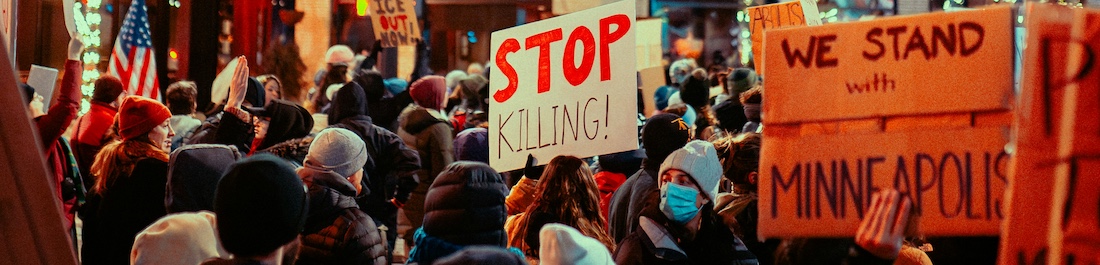
Many Minnesotans of faith attended the No Kings 3 rally at the state capitol this past Saturday as an opportunity to put their values into action. Participants including Christians, Muslims, and Jews attended the event as a moral commitment to justice, compassion, and the protection of democratic values over authoritarianism. Their actions mirrored their religious beliefs and showed their objection to Christian Nationalism.
The next day, on Palm Sunday, many Christians returned to the capitol to take a stand against the avarice, inhumanity, and brutality of the current administration thus recalling Jesus humbly entering Jerusalem on the original Palm Sunday as a response to the corruption of the Roman Empire.
Coming Soon: General Strike on May 1
-submitted by Joe L
[ photo credit ]
Marching in the Name of the Passover, Easter God
Mar. 31, 2026 10:17 Filed in: Commentaries
 Friends,
 On Sunday, I preached about the first Palm Sunday, and the ways the defiant story of the Passover made Jesus' procession into occupied Jerusalem a dangerous, provocative event. Matthew's Gospel says that "the whole city was in turmoil" as Jesus entered, and then tossed those exploiting the people out of the Temple, and healed the sick. "Who is this?!?," the people of Jerusalem asked?
Who is this? Who do we say Jesus is?
It's an urgent time for the church to be able to speak clearly about who Jesus is. As voices around us claim that Jesus is a figure of judgment who will ride in on a white battle-horse with an army of avenging angels, we proclaim a Gospel that is actually Good News.
Listen to the rest of the sermon here.
With love,
Susan+
[ photo credit ]
Hope and Despair, Together
Mar. 25, 2026 13:59 Filed in: Commentaries
 Friends,
There was a line in Lydia’s sermon last week that really hit home for me. Lydia said, “We are sent forth in the name of Christ, back out into the world of mundane to-do lists, blatant fascism, and joyful birthday parties.”
Holding all of it—the daily details, the heartbreak and fear, and the joy—is the human condition. And God joins us in it: "Our God cannot help but feel his way through, even in the most divine moments. Hope and despair are not mutually exclusive.”
Listen to the rest of Lydia's sermon here.
With love,
Susan+
[ photo credit ]
Joining God's Work of Healing
Mar. 21, 2026 08:39 Filed in: Commentaries
 Friends,
 In Sunday's sermon, I preached about a town filled with fear. When Jesus arrives and gives sight to a man who had been blind his whole life, instead of joining the man in celebration, they react with suspicion and throw him out. The way they respond to this man, and the miracle he receives, is a glimpse into what fear does at the societal scale.
All of us have been living in this story in recent months. We’ve been a community wracked with fear that has to choose how to relate to their most vulnerable neighbor. The Twin Cities had to decide: Would we sacrifice the immigrant neighbors among us in order to avoid a military occupation?
Read the rest here.
With love,
Susan+
[ photo credit ]
Seeing Through the Filter
Mar. 13, 2026 10:27 Filed in: Commentaries
 Beloved in Christ,
One delusion of modern life is the assumption that it is possible to see the world objectively, and without bias. Our brains take in about eleven million bits of information per second, and our conscious minds can only process about fifty bits. That’s an enormous gap, and our minds close that gap by using unconscious filters to select what to see and predict what is likely to happen. Those filters are made of what we believe or value most. So, it turns out, it’s not so much that seeing is believing, but rather we have to believe in order to see.
Following Jesus is about learning to see through the filter of God’s sacrificial, neighborly love. In this Sunday’s dense and complex gospel reading, Jesus is helping us to understand that true, healing vision is only found when we let go of faith in ourselves, and practice clinging entirely to God’s power.
Learning to see through the eyes of Jesus will give us a bias for love. It will develop a filter for generosity in a world of rancor and scorn, shine a warm and healing light on the poor and those pushed aside in a world where might makes right. Our spiritual work in every moment is to ask Jesus to touch the scales of hard-hearted selfishness, bitterness, and fear that ever blind us, and put on the lens of love, and the filter of justice. Through daily prayer, sharing life with each other, drinking deeply from the scriptures, and encountering Jesus in sacrament, God’s vision for a world healed by love comes into sharper focus, and we are set free to extend that healing in every moment of our living, in a world imprisoned by its destructive blindness.
Grace and Peace,
The Right Reverend Craig Loya
Bishop X
Episcopal Church in Minnesota
[ photo credit ]
The Hot, Parched Wilderness
Mar. 11, 2026 15:27 Filed in: Commentaries

From Bishop Loya
Beloved in Christ,
Last summer, a bike trip with my daughter through Iowa coincided with a brutal heat wave. At one point, we found ourselves in the middle of a long stretch between towns, running low on water. There was only one way for us to get out of the heat and find water, to keep going. We eventually reached our destination, exhausted, hot, and full of complaint. Then, we found an ice cream place, ordered water and the largest root beer floats they could make, and consumed them greedily in the glorious air conditioning. It was spiritually transcendent, and made the hot trip back much, much easier.
In the Old Testament reading for this Sunday, God’s people are also in the middle of a long and hot journey in the desert wilderness. There is no water, they cry out in complaint to Moses, who turns around and cries out in complaint to God. God directs him to strike a rock with his staff, and water inconceivably comes running out, no doubt as sweet as our root beer floats in Iowa.
The world feels every bit a hot and parched wilderness right now. The most powerful in our nation and the world are recklessly enforcing a narrow vision at home, and now in the already embattled Middle East, as bombs wreak death and destruction through the region with little sense of how or when it will all end, and the potential for widening violence alarmingly high.
In such a moment, we are called to stand in the long biblical tradition of lament, and cry out to God for justice, for peace, and for healing. The only way we can get out of the heat and find water is to keep going, seeking with our whole being the living water that God alone can offer. And then, fortified by that water, we are to pedal through the world with the same elated energy as my daughter and I did on our root beer fueled return trip through Iowa’s scorching cornfields. We are to pedal calling on our elected leaders to end the state sanctioned campaigns of violence, around the world, and in our own streets. We are to pedal in calling for accountability for those who recklessly disregard the basic constitutional rule of law. We are to pedal by doing every small thing we can do in front of us with the greatest imaginable love.
Make no mistake, beloved, the God we meet around the altar each and every week can provide the sweetest water out of the hardest surfaces, and the most impossible circumstances. May our life together always be about joining God in striking every hard, calcified, and brittle barrier, until the healing medicine of love flows unstoppably over the whole parched and painful creation.
Grace and Peace,
The Right Reverend Craig Loya
Bishop X
Episcopal Church in Minnesota
[ photo credit ]
Learning to Float
Mar. 07, 2026 13:16 Filed in: Commentaries
 Friends,
 In Sunday's sermon, I asked you what it was like as you were learning to float.
You shared your experiences: terror, panic, and fear. And after you learned: wonder, magic, freedom.
Trusting God is a little like that. The days ahead, in this extraordinarily volatile political time, will give us more and more opportunities to trust God as we practice Jesus' way of love. You can listen to the sermon here.
With love,
Susan+
[ photo credit ]